
Introduction:
When it comes to crafting high-quality content that both readers and search engines love, transition words play a critical role. These small but powerful connectors help guide your audience through ideas smoothly while improving your SEO score. Whether you are writing a blog post, article, or PBN content for link-building, transition words make your content flow logically and keep readers engaged longer.
In SEO writing, readability is key. Search engines like Google value content that’s easy to understand and structured logically. Using transition words effectively can improve readability scores, boost engagement metrics, and enhance your content’s authority.
What Are Transition Words?
Transition words—also known as linking words or connecting phrases—are terms that help establish relationships between sentences, paragraphs, or ideas. They create coherence and ensure a logical flow in your writing.
For example:
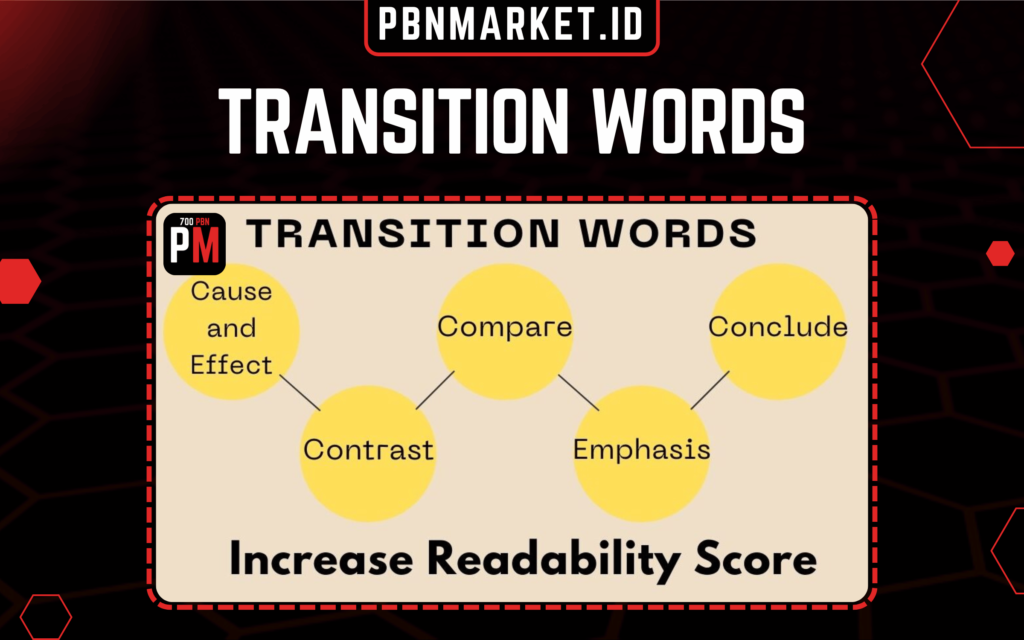
- Addition: Furthermore, moreover, also, in addition
- Contrast: However, on the other hand, nevertheless
- Cause and Effect: Therefore, thus, consequently, as a result
- Comparison: Similarly, likewise, in the same way
- Conclusion: Finally, in conclusion, to sum up
These words work as the glue that holds your ideas together. Without them, your writing can feel abrupt, disconnected, or confusing to readers.
The SEO Power of Transition Words
Transition words are not just about readability—they directly influence SEO performance. Here’s how:
1. Improved Readability Score
Google’s algorithms and tools like Yoast SEO analyze how easy it is to read your content. Transition words help you achieve a higher readability score, signaling to search engines that your content is user-friendly.
2. Better User Experience
A good flow keeps readers on your page longer. The longer visitors stay, the better your engagement metrics (like dwell time and bounce rate), which indirectly boosts your rankings.
3. Enhanced Content Structure
Transition words make your content easier to skim. This structure helps readers quickly grasp your points, which is vital for PBN articles or SEO-optimized blogs aiming to capture quick attention.
4. Stronger Internal Linking and Contextual Relevance
When used alongside internal links, transition words enhance contextual flow. For example:
“Moreover, if you want to explore advanced link-building strategies, visit our SEO Services page.”
This creates a smooth, reader-friendly link insertion—ideal for PBN websites like pbnmarket.id.
Types of Transition Words and Their Uses
Let’s dive deeper into the categories of transition words and how to use them effectively in SEO writing.
1. Addition Transition Words
Used to introduce new ideas or points related to the previous one.
Examples: Furthermore, also, in addition, moreover, besides
Example in a sentence:
Furthermore, using high-quality backlinks can significantly improve your site’s authority.
2. Contrast Transition Words
Used to show differences or opposing ideas.
Examples: However, nevertheless, on the contrary, on the other hand, yet
Example in a sentence:
SEO takes time to show results; however, consistent optimization ensures long-term growth.
3. Cause and Effect Transition Words
Used to connect reasons with results.
Examples: Therefore, thus, consequently, as a result, hence
Example in a sentence:
Your ranking dropped; therefore, you need to update your content strategy.
4. Comparison Transition Words
Used to draw similarities between ideas.
Examples: Likewise, similarly, in the same way
Example in a sentence:
Similarly, PBN links work like guest posts when done with quality control.
5. Time or Sequence Transition Words
Used to describe events or ideas in order.
Examples: First, next, then, afterward, finally
Example in a sentence:
First, choose your niche; then, build content clusters for stronger topic relevance.
6. Emphasis Transition Words
Used to highlight important points.
Examples: Indeed, in fact, especially, above all
Example in a sentence:
Indeed, using transition words can make your writing more professional and engaging.
7. Conclusion Transition Words
Used to summarize or close an idea.
Examples: In conclusion, to sum up, overall, finally
Example in a sentence:
In conclusion, transition words are essential for creating high-quality SEO articles.
How to Use Transition Words in SEO Writing
Using transition words effectively requires strategy. Here’s how to make the most of them in your content:
1. Maintain Natural Flow
Don’t force transition words into your text. Instead, use them naturally to connect ideas. Overuse can make your content sound robotic.
2. Distribute Evenly Across Paragraphs
Ensure that at least 30% of your sentences include transition words. Tools like Yoast recommend this ratio for readability optimization.
3. Match the Tone and Purpose
Select transition words that fit the context. For example, use however for contrast and furthermore for adding related ideas.
4. Combine with Active Voice
Pairing transition words with active verbs enhances engagement. For example:
Therefore, our team improves on-page elements to maximize traffic.
5. Use in Introductions and Conclusions
Start your paragraphs with transition words to signal the reader about the flow of thought, and end your article with smooth transitions for closure.
Transition Words in PBN Articles
For PBN websites like pbnmarket.id, transition words hold special importance. Since PBN content often serves as supporting articles for backlink placement, readability and SEO optimization are crucial.
Here’s why:
1. Increases Link Placement Value
Transition words help naturally integrate backlinks without making them look forced.
Example:
Moreover, you can explore our PBN services to get high-quality backlinks for your business.
2. Improves Content Authenticity
Google is getting smarter at detecting low-quality or AI-generated content. Proper use of transition words makes your writing appear natural and human-like.
3. Supports Thematic Consistency
When building multiple PBN articles under one niche, transition words help maintain logical flow across content pieces—making your PBN network appear more organic.
4. Boosts Engagement Metrics
Even PBN articles benefit from longer user sessions. Well-structured, readable content keeps visitors scrolling, improving the overall credibility of your network.
Common Mistakes to Avoid When Using Transition Words
While transition words are powerful, misusing them can harm your writing quality. Here are the most common mistakes:
1. Overstuffing
Repeating the same transition words in every paragraph can reduce impact and make your content sound repetitive. Vary your word choice.
2. Using Irrelevant Transitions
Ensure that the transition matches the relationship between sentences. Using however when you’re not introducing a contrast confuses readers.
3. Neglecting Paragraph Openers
Start new sections with a transition word to indicate flow. Skipping them can make your text appear disconnected.
4. Forgetting the Reader
Transition words should serve the reader, not the SEO algorithm. Always prioritize readability and clarity over keyword placement.
Best Practices for Using Transition Words in SEO Articles
Follow these practical tips to enhance both user experience and SEO performance:
- Use a mix of transition categories—don’t rely on one type.
- Keep sentences short and clear—long sentences weaken the effect.
- Optimize for readability tools—maintain at least 30% transition usage.
- Include transitions in anchor text context—this keeps backlinks natural.
- Use transitions in headings—it boosts engagement and flow between sections.
Example heading improvement:
❌ Tips for Better SEO Writing
✅ Furthermore: 5 Tips for Better SEO Writing You Can Apply Today
Tools to Help You Optimize Transition Word Usage
If you want to improve your writing, several SEO and grammar tools can help you analyze and optimize transition words:
- Yoast SEO: Provides readability analysis with a transition word score.
- Grammarly: Suggests smoother connectors for flow improvement.
- Hemingway App: Highlights complex sentences that may need transitions.
- ProWritingAid: Offers detailed reports on cohesion and readability.
Using these tools ensures your PBN or blog content aligns with SEO best practices.
Examples of Transition Word Usage in SEO Content
Let’s see how transition words can transform plain sentences into engaging, SEO-friendly writing:
Without transition words:
“SEO improves visibility. It drives traffic. You can use backlinks. The results come slowly.”
With transition words:
“SEO improves visibility, and moreover, it drives targeted traffic. In addition, by using quality backlinks, you can strengthen your domain authority. However, remember that results take time and consistency.”
The second example sounds smoother, professional, and reader-friendly—all thanks to transition words.
The Role of Transition Words in Content Marketing
Transition words are not just for SEO—they’re vital across the broader content marketing strategy. From blog posts to newsletters, and from PBN articles to guest posts, they help maintain a consistent tone and flow.
- For Blogs: Keep readers hooked with seamless progression of ideas.
- For Sales Copy: Create persuasive, logical sequences leading to calls-to-action.
- For PBNs: Add natural structure to link-heavy content.
- For Email Campaigns: Improve clarity and conversational tone.
In every format, transition words make your message clearer and more impactful.
Transition Words and AI-Generated Content
As AI tools become common in content creation, maintaining natural flow is more challenging. AI often produces rigid or repetitive text. By strategically inserting transition words, you can humanize AI-generated articles and make them appear authentic.
This is particularly useful for PBN managers who use AI-assisted writing to scale their network. Transition words ensure the final output passes manual reviews and search engine quality checks.
Conclusion: Transition Words – The Silent Boosters of SEO Content
In conclusion, transition words are far more than just grammatical connectors—they’re the key to smooth, structured, and SEO-optimized writing. Whether you’re writing a blog post, landing page, or PBN article, they help maintain readability, boost engagement, and enhance the natural placement of keywords and backlinks.
For websites like pbnmarket.id, where SEO and link-building are at the core of operations, mastering transition words ensures every piece of content supports both user experience and ranking performance.
So next time you write or edit an article, pay attention to how your ideas connect. Insert the right transition words naturally, and watch your content’s clarity—and SEO impact—skyrocket.

Rolou algum bônus grátis da Bet7k por aí? Tô sempre de olho pra aproveitar as promoções! Se souberem de algo, mandem a dica! bet7k bônus grátis