Introduction:
Search Engine Optimization (SEO) is made up of many moving parts, but one strategy that consistently delivers results is internal linking. Internal links are the backbone of a well-optimized website, guiding both users and search engine crawlers through your content. For Private Blog Networks (PBNs) and money sites, mastering internal linking can mean the difference between average rankings and dominating the SERPs.
This guide will break down everything you need to know about internal linking: what it is, why it matters, how to do it properly, and advanced strategies you can apply to both PBNs and your main websites.
What Is Internal Linking?
An internal link is a hyperlink that connects one page of a website to another page on the same domain. Unlike external links, which point to outside websites, internal links remain within your own site ecosystem.
Examples of internal links:
- Navigation menus
- In-content anchor text links
- Related articles sections
- Footer links
Search engines like Google use these links to discover content, understand the hierarchy of pages, and evaluate the importance of each page.
Why Internal Linking Matters for SEO
Internal linking plays a critical role in your SEO strategy, especially for PBNs and affiliate or service websites.
1. Improves Crawlability
Googlebot crawls websites by following links. A well-structured internal linking system ensures that every important page gets crawled and indexed.
2. Distributes Link Equity
Not all pages on your site have equal authority. Internal links pass “link juice” (PageRank) from stronger pages (like high-performing blog posts or homepages) to weaker pages (like new articles or service pages).
3. Enhances User Experience
Good internal linking keeps users engaged longer by directing them to relevant content. This reduces bounce rate and improves dwell time—two positive SEO signals.
4. Builds Topic Relevance
Strategically linking related content signals to Google that your site is an authority in that niche. For example, if multiple blog posts about SEO all point to your “Internal Linking Guide,” Google sees it as a cornerstone piece.
5. Maximizes PBN Power
In a PBN setup, your internal linking structure helps funnel link juice from the homepage and high-authority posts to the pages you want to rank. Without proper internal linking, even the strongest PBN will lose potential.
Best Practices for Internal Linking
To fully leverage the benefits of internal linking, you must follow best practices that work for both money sites and PBNs.
1. Use Descriptive Anchor Text
Anchor text is the clickable text in a link. Instead of using “click here,” use keyword-rich phrases like “SEO internal linking strategies.” This helps search engines understand the context.
Example:
“Learn more about private blog networks (PBNs).”
“Click here.”
2. Link to Deep Pages
Most websites overlink to their homepage or top-level categories. Instead, focus on deep linking to articles, service pages, or landing pages that need authority boosts.
3. Keep Links Contextual
Contextual links inside the body of content are the most powerful. Google values links surrounded by relevant text more than navigation or sidebar links.
4. Maintain a Natural Flow
Avoid keyword stuffing or overlinking. A good rule is 1–3 internal links per 500 words, but adjust depending on content length and relevance.
5. Prioritize Important Pages
Identify cornerstone or money pages (service pages, product reviews, affiliate content) and ensure multiple other articles point to them.
6. Fix Orphan Pages
An orphan page is a page that has no internal links pointing to it. These pages are invisible to Google. Regularly audit your site to make sure every page has incoming links.
Internal Linking Strategies for PBN Sites
When managing a Private Blog Network, internal linking becomes even more strategic. Unlike money sites, PBNs are built mainly for passing link equity. Here’s how to optimize them:
1. Funnel Authority from Homepage
The homepage usually has the most backlinks. Link from it to a few strong inner posts, which can then link contextually to your money site.
2. Create Topical Clusters
Group related posts together. For example, a PBN about SEO could have a cluster on “link building,” with each post linking to others in the cluster. This creates a strong topical signal.
3. Use Outbound Links Wisely
Balance internal and outbound links. Don’t just link to your money site—add links to authority sites (like Wikipedia or industry leaders) for a natural profile.
4. Rotate Anchor Texts
Avoid exact-match anchors repeatedly. Use variations, branded anchors, and generic terms to reduce footprint risk.
5. Keep Link Depth Low
Make sure important outbound links (to your money sites) are no more than 2–3 clicks away from the homepage of your PBN.
Internal Linking Strategies for Money Sites
For your main website, the focus should be on building topical authority and improving user experience.
1. Build Content Hubs
Create a pillar page (long-form, comprehensive guide) and interlink it with supporting blog posts. This cluster approach boosts authority.
Example for SEO niche:
- Pillar: “The Ultimate Guide to SEO”
- Cluster articles: “On-Page SEO Checklist,” “Technical SEO Basics,” “Internal Linking Best Practices”
2. Balance Between Top and Bottom Funnel Pages
Don’t just push link juice to commercial pages. Mix in blog posts, case studies, and informational guides to build topical authority and attract natural backlinks.
3. Breadcrumb Navigation
Breadcrumbs are not only user-friendly but also provide extra internal links for crawlers.
4. Contextual Linking in Blogs
Every new blog post should link to at least 2–3 older posts and be linked back from existing ones. This keeps your content network alive.
5. Sitewide Linking Opportunities
Leverage menus, sidebars, and footers but don’t overdo it. Sitewide links can look spammy if excessive.
Common Internal Linking Mistakes to Avoid
Even experienced SEOs sometimes make mistakes with internal linking. Watch out for these pitfalls:
- Over-Optimization – Using exact-match anchors everywhere can trigger Google penalties.
- Broken Links – Dead internal links frustrate users and hurt SEO.
- Too Many Links – Cramming 50+ links in one post dilutes link equity.
- Ignoring User Intent – Linking just for SEO without considering user needs reduces engagement.
- One-Way Linking – Always ensure reciprocal relevance between pages.
Tools for Internal Linking
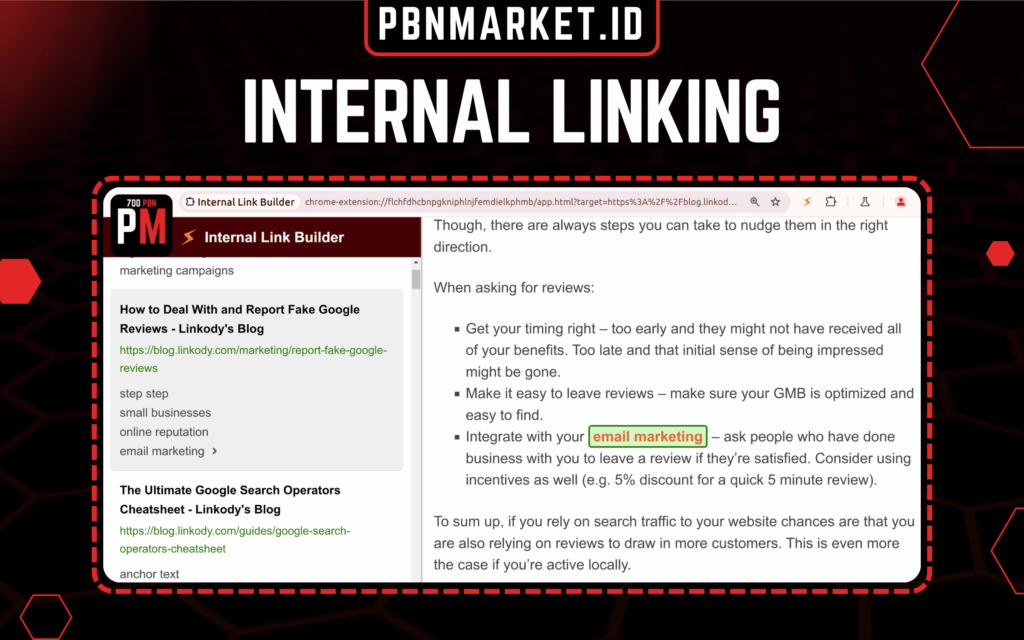
Manually creating and tracking internal links can be overwhelming, especially with large PBNs or authority sites. Here are some tools that make the job easier:
- Ahrefs Site Audit – Identifies orphan pages and broken internal links.
- Screaming Frog SEO Spider – Maps out your internal link structure.
- Yoast SEO (WordPress Plugin) – Suggests relevant internal links while writing.
- Link Whisper – Automates internal linking for WordPress sites.
Advanced Internal Linking Tactics
If you want to take things to the next level, consider these advanced methods:
1. Silo Structure
Organize your website into silos where related content stays tightly connected. For example:
- Silo 1: On-Page SEO
- Silo 2: Off-Page SEO
- Silo 3: Technical SEO
Each silo links internally but rarely across silos. This maximizes topical authority.
2. PageRank Sculpting
Use no follow on low-value internal links (like privacy policy) to channel more link juice to money pages.
3. Seasonal Linking
If you run seasonal content (e.g., “Black Friday SEO Deals”), link to it from evergreen content during peak months.
4. A/B Testing Internal Links
Experiment with different anchor texts, placements, and link counts to see what drives better engagement and rankings.
5. Heatmap Analysis
Use tools like Hotjar to track where users click most. Place internal links where they naturally get attention.
Internal Linking for Long-Term SEO Success
Unlike backlinks, which can be lost if a referring domain disappears, internal links remain under your control. For long-term SEO, internal linking provides:
- Stability – You can always adjust your structure.
- Scalability – New pages can easily be integrated.
- Sustainability – Reduced dependency on external backlinks.
For PBN owners, this means you can maximize the value of each domain in your network, while for money sites, it ensures that every page receives proper authority distribution.
Conclusion:
Internal linking is more than just connecting one page to another—it’s about building a strategic network of relevance and authority within your website. Whether you’re running a PBN or growing a money site, internal linking is one of the most powerful yet underutilized SEO tactics.
By following best practices, avoiding common mistakes, and applying advanced strategies like siloing and PageRank sculpting, you can dramatically improve both user experience and search engine rankings.
For PBN-based sites like pbnmarket.id, mastering internal linking not only ensures maximum SEO power but also creates a sustainable, scalable framework for ranking money sites higher in Google.